JACKSON COUNTY, MS (WLOX) - Saturday's "Battle on the Bayou" kayak and canoe race in Jackson County was a big hit. In just it's second year, the number of participants was nearly double last year's turnout.
And they came to the coast from as far away as California and Wisconsin. A total of 190 boats left the starting point at Gulf Hills Resort, with participants paddling nearly 10 miles along Fort Bayou to the finish line at "The Shed."
Colorful kayaks covered the waters of Fort Bayou behind Gulf Hills Resort. Racers warmed up and jockeyed for position before the cannon sounded to start the second "Battle on the Bayou."
Showing posts with label Mississippi Gulf Coast. Show all posts
Showing posts with label Mississippi Gulf Coast. Show all posts
Monday, March 14, 2011


Tuesday, October 19, 2010
Lucy’s Revenge Closes in on $10K, Breaks 300 Miles in Alzheimer’s Fundraising Effort
Mississippi Paddler asks East Mississippi health care officials and residents for help.
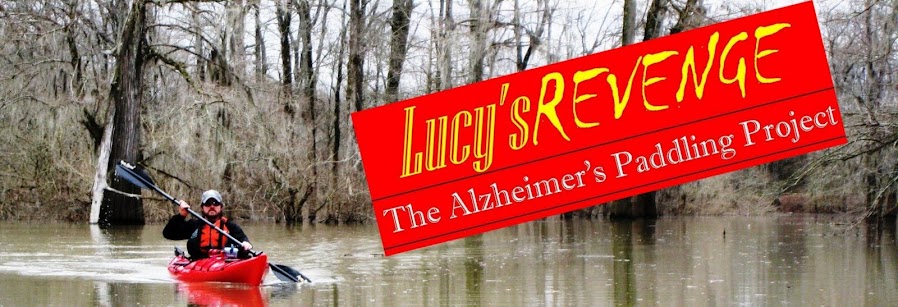
Flora, MS. October 19, 2010—Keith Plunkett, Mississippi paddler and organizer of Lucy’s Revenge, has paddled over 300 miles in the yearlong effort to raise money for and awareness of Alzheimer’s Disease on Mississippi waterways. Joining a group of eight other kayakers on October 16, Plunkett launched from Bell Fontaine Point in Ocean Springs in route across the Mississippi Sound to Horn Island. Plunkett says he was driven to paddle a few extra miles while out on the island in order to be sure he met the 300-mile mark by the time the group may landfall to end the trip.
“South Coast Paddling Company and Mississippi Gulf Coast residents have been a huge help to the project on the coast and I wanted to be sure and hit this milestone there,” said Plunkett. “The Horn Island trip was a South Coast Paddling sponsored trip, so they did all the planning. I hadn’t mapped it before hand, and I wanted to be sure I got the mileage in.”
With that worry in mind, Plunkett awoke on the west end of Horn Island on Sunday morning and decided to put in a few extra miles before joining back up with the group. Paddling south of the island to Buoy 1 at Dog Keys Pass, he added an extra 6.6 miles, and had some unexpected but welcome company on the way back to the island.
“The first buoy is a little over 3 miles south of the island out into the open Gulf,” said Plunkett. “It was a little nerve wracking to look back and see Horn Island as a little speck behind me. I felt pretty small and vulnerable out there. But on the way back I got an escort from about 8 to 10 bottlenose dolphin, and that helped calm my nerves. They are beautiful animals.”
When Plunkett landed again at Bell Fontaine Point on Sunday afternoon he had logged another 29.5 miles bringing his totals for the project to 305.8.
The Flora resident began kayaking just over a year ago and says he wasn’t around the water much as a child, but is growing more confident in his paddling ability every day.
“In mid-July I thought I had reached the far reaches of my distance for a weekend paddling trip when Sharon and I floated a 45 mile trip on the Wolf River. Less than two months later we kayaked over 86 miles from Shubuta to Leaksville on the Chickasawhay River. About a week ago, I paddled in the Ninth Annual Phatwater Challenge on the Mississippi River. On that trip I managed to paddle nearly the same mileage that had taken me a full three days only three months earlier, and I did it in less than 6 hours. My ability and confidence has grown by leaps and bounds.”
Plunkett kicked off a yearlong effort to paddle over 600 miles of Mississippi waterways in July on the Gulf Coast. A goal he says he now expects to exceed by the projects end date in June 2011. He began focusing on waterways in the East Mississippi Region in September, but due to drought conditions and interest from other parts of the state he’s not done as much in the area as hoped.
“East Mississippi has many of the jewels of our state’s paddling waterways,” he said. “I really need some more help from East Mississippi, and some sponsors to step forward. This disease knows no boundaries. I know there are people and caregivers there that need the support, and I want to be there.”
So far, Plunkett has been on the coastal waterways of Old Fort Bayou, Davis Bayou, Wolf River, Escatawpa River and the Pascagoula River. He has paddled sections of the Pearl River, Strong River and Mississippi River. He and wife Sharon also completed an 86-mile trip on the Chickasawhay River in East Mississippi on Labor Day Weekend. Plunkett has raised $8,600 for the Mississippi Chapter of the Alzheimer’s Association since July while paddling through 14 Mississippi counties.
Stories, videos, and photos are posted to the website, www.lucysrevenge.com . General Donations and Sponsorship Opportunities links on the website connect donors directly to the Alzheimer’s Association website.
The project is named in memory of Plunkett’s Grandmother, Lucy Plunkett, who suffered from Alzheimer’s before succumbing to the disease in 1993. The matriarch of the Plunkett family reared six children, and oversaw the upbringing of 9 grandchildren. She was a housewife and an active member of her church and the rural community of Little Yazoo in Yazoo County.
Flora, MS. October 19, 2010—Keith Plunkett, Mississippi paddler and organizer of Lucy’s Revenge, has paddled over 300 miles in the yearlong effort to raise money for and awareness of Alzheimer’s Disease on Mississippi waterways. Joining a group of eight other kayakers on October 16, Plunkett launched from Bell Fontaine Point in Ocean Springs in route across the Mississippi Sound to Horn Island. Plunkett says he was driven to paddle a few extra miles while out on the island in order to be sure he met the 300-mile mark by the time the group may landfall to end the trip.
“South Coast Paddling Company and Mississippi Gulf Coast residents have been a huge help to the project on the coast and I wanted to be sure and hit this milestone there,” said Plunkett. “The Horn Island trip was a South Coast Paddling sponsored trip, so they did all the planning. I hadn’t mapped it before hand, and I wanted to be sure I got the mileage in.”
With that worry in mind, Plunkett awoke on the west end of Horn Island on Sunday morning and decided to put in a few extra miles before joining back up with the group. Paddling south of the island to Buoy 1 at Dog Keys Pass, he added an extra 6.6 miles, and had some unexpected but welcome company on the way back to the island.
“The first buoy is a little over 3 miles south of the island out into the open Gulf,” said Plunkett. “It was a little nerve wracking to look back and see Horn Island as a little speck behind me. I felt pretty small and vulnerable out there. But on the way back I got an escort from about 8 to 10 bottlenose dolphin, and that helped calm my nerves. They are beautiful animals.”
When Plunkett landed again at Bell Fontaine Point on Sunday afternoon he had logged another 29.5 miles bringing his totals for the project to 305.8.
The Flora resident began kayaking just over a year ago and says he wasn’t around the water much as a child, but is growing more confident in his paddling ability every day.
“In mid-July I thought I had reached the far reaches of my distance for a weekend paddling trip when Sharon and I floated a 45 mile trip on the Wolf River. Less than two months later we kayaked over 86 miles from Shubuta to Leaksville on the Chickasawhay River. About a week ago, I paddled in the Ninth Annual Phatwater Challenge on the Mississippi River. On that trip I managed to paddle nearly the same mileage that had taken me a full three days only three months earlier, and I did it in less than 6 hours. My ability and confidence has grown by leaps and bounds.”
Plunkett kicked off a yearlong effort to paddle over 600 miles of Mississippi waterways in July on the Gulf Coast. A goal he says he now expects to exceed by the projects end date in June 2011. He began focusing on waterways in the East Mississippi Region in September, but due to drought conditions and interest from other parts of the state he’s not done as much in the area as hoped.
“East Mississippi has many of the jewels of our state’s paddling waterways,” he said. “I really need some more help from East Mississippi, and some sponsors to step forward. This disease knows no boundaries. I know there are people and caregivers there that need the support, and I want to be there.”
So far, Plunkett has been on the coastal waterways of Old Fort Bayou, Davis Bayou, Wolf River, Escatawpa River and the Pascagoula River. He has paddled sections of the Pearl River, Strong River and Mississippi River. He and wife Sharon also completed an 86-mile trip on the Chickasawhay River in East Mississippi on Labor Day Weekend. Plunkett has raised $8,600 for the Mississippi Chapter of the Alzheimer’s Association since July while paddling through 14 Mississippi counties.
Stories, videos, and photos are posted to the website, www.lucysrevenge.com . General Donations and Sponsorship Opportunities links on the website connect donors directly to the Alzheimer’s Association website.
The project is named in memory of Plunkett’s Grandmother, Lucy Plunkett, who suffered from Alzheimer’s before succumbing to the disease in 1993. The matriarch of the Plunkett family reared six children, and oversaw the upbringing of 9 grandchildren. She was a housewife and an active member of her church and the rural community of Little Yazoo in Yazoo County.
Thursday, September 9, 2010
Alzheimer's Support from IP: $10,000 for Gulf Coast Memory Walk
 |
| The Alzheimer’s Association Gulf Coast Memory Walk has received a show of support in the form of a $10,000 sponsorship from the IP Casino Resort Spa. The contribution marks the first of its size for the Walk and is demonstrated in the larger than life-sized check that is displayed by, from left, Sara Murphy and Ian MacDonald, both of the Alzheimer’s Association; Cindi Braud, 2010 Gulf Coast Memory Walk ambassador; Jon Braud; Patty Dunn, Alzheimer’s Association executive director; and Elaine Stevens, IP public relations manager. |
Motivation for the support stemmed from a diagnosis of early onset Alzheimer’s. When Cindi Braud, an IP casino host, and her husband Jon shared his diagnosis, the company immediately made plans to work with the couple.
According to Cindi and Jon, “We are very excited to work with the Alzheimer’s Association and look forward to promoting awareness for this disease. In addition, we are overwhelmed by the support IP Casino has given us and are forever grateful to IP for their commitment to Alzheimer’s awareness.” Cindi is serving as the 2010 Gulf Coast Memory Walk Ambassador.
"IP always takes care of its own, and Cindi Braud is a vital part of the IP family. When we discovered her husband Jon was diagnosed with early onset Alzheimer’s, IP’s partnership with the Alzheimer’s Association was a given. We are proud to support Cindi, Jon and the many thousands of others impacted by this dreaded disease,” said Elaine Stevens, IP public relations manager.
In accepting the donation, Patty Dunn, the chapter’s executive director, said, “We welcome this generous show of support in our efforts to enhance the care and support for those affected by Alzheimer’s disease. Alzheimer’s disease is an escalating public health crisis that has far-reaching effects on individuals, families and businesses. This donation from IP Casino Resort Spa represents the beginning of a partnership to increase concern and awareness for Alzheimer’s disease and the efforts of the Alzheimer’s Association.”
On hand for the check-presenting occasion were Ms. Stevens, Cindi Braud, Jon Braud, and Tina Cantrell, executive casino host. Representing the Mississippi Chapter Alzheimer’s Association were Ms. Dunn, Sara Murphy and Ian MacDonald.
Ms. Dunn pointed out that every 70 seconds someone develops Alzheimer’s disease, and in Mississippi, it is estimated that 53,000 individuals are living with Alzheimer’s disease.
Monday, August 30, 2010
Lucy’s Revenge Caregiver Chronicles: Ocean Springs Couple Fighting Alzheimer’s With Help of Friends and Family
BY: B. Keith Plunkett
You don’t drown by falling into water. You drown by staying there. -- Robert Allen
 |
| Cindi and Jon Braud |
For many people, Alzheimer’s is an elderly person’s disease. Sadly, this misconception may be why some people don’t give it the attention it deserves when considering worthy causes to support. Despite her busy schedule at IP, Cindi is out to change all that. Alzheimer's is a disease of the brain that causes problems with memory, thinking and behavior. It is the seventh leading cause of death in the country and the fifth leading cause of death for those over age 65. Contrary to public opinion, it is not a normal part of aging and currently the cause of Alzheimer's disease is unknown. What many people don’t understand is that a growing segment of those diagnosed are much younger than 65. Cindi’s husband Jon is among that group. Jon Braud was diagnosed at the age of 40. He is now 42.
Cindi explains that the diagnosis was not a complete surprise. The Ocean Springs couple knew the genetics were there, and that the disease could touch them as it had prior generations of the Braud family. Jon’s father was diagnosed at the age of 44, a mere 23 months before his death. Likewise, Jon’s Grandmother and a cousin were taken by the disease at the ages of 50 and 51, and a Granduncle died just after turning 40. It was because of these familial reasons that Jon and Cindi decided early on not to have children. The chances were simply too great that the Alzheimer’s disease gene would be passed along. Early Onset Alzheimer’s Disease (EOAD) is more about genetics than any other subset of the disease. The couple made a conscious effort to end the disease in the Braud family with Jon.
The decision the Braud’s made to forego having children is an honorable one and one of necessity. It illustrates how Alzheimer’s is not only affecting individuals and their caregivers, but also generations of entire families. Strides have been made in the past decade to ease the affects of Alzheimer’s symptoms with some success, but there is still no cure. Cindi believes the lack of knowledge keeps medical professionals out of the fight. The Braud’s have visited a few medical facilities with less than supportive results. Just last July, Jon’s Neurologist summed up the current lack of medical resources when he told him, “Its Alzheimer’s, I’m sorry there is nothing I can do for you.”
Other facilities also found reasons not to help the Braud’s. The Lou Ruvo Brain Institute in Las Vegas turned the couple away because they did not live in Nevada. An administrator at the famed Mayo Clinic said, “We’re not the miracle hospital everyone thinks we are.” And, the Pennington Bio-Medical Center in nearby Baton Rouge summed up what those with EOAD face in the competitive research money race. Simply put, they said, “There is no money in saving the 1% with the disease.”
But, if there is one thing Cindi Braud is, it is persistent. She, along with 50 family members and friends, has embarked on a crusade to email every medical facility and doctor associated with Alzheimer’s at every University in the country.
“I hope that they will be so inundated with emails regarding Jon and us asking for help that someone might be able to. Squeaky wheel gets the grease,” she said.
Cindi is also hoping to toy with a few egos and the facilities desire to compete for research dollars. She says it has already worked with UCLA.
“UCLA told me there was nothing they could do for us and they referred me to a doctor at UCSD. I emailed UCSD, and they replied with a ‘yes’ as they are doing stem cell research,” says Cindi. “When we concluded our conversation (UCSD) copied the doctor at UCLA (on the email). Within 2 hours I received a phone call from UCLA inviting us out there for research.”
Cindi’s employer has joined in the fight. IP Casino’s Benefits Manager has helped with everything from insurance questions to accommodating Cindi through Family Medical Leave. IP is also donating $10K to the Alzheimer’s Association (ALZ) and will hold signups for teams for an Alzheimer’s Association Memory Walk in November. In January the company will hold an event to promote awareness and provide information for Gulf Coast residents.
The Braud’s are not alone in their inability to find resources. Here in Mississippi, an estimated 148,000 caregivers are working tirelessly to provide for the 53,000 loved ones affected by the disease with little or no support. Only now are medical facilities beginning to recognize the dire need across the state, and that the disease takes a toll not only on the patients, but on those working hard to provide care.
“There is no assistance on the Gulf Coast for our situation,” says Cindi. “When I first called ALZ in September 2009 they asked me if I had my financial affairs in order and had I picked out an assisted living facility. That was unacceptable to me. It’s one of the many reasons I fight so hard.”
“I want to change the way ALZ responds when someone is calling for help,” she added. “When you hear the diagnosis for the first time you already understand the finality of the disease. Tell me who is willing to fight it, cure it…not, ‘have I picked out his tombstone?’.”
Cindi’s investigation into the disease continues to show the need for more awareness in the medical community. She says that people continue to be “shocked” when she tells them her 42-year old husband has the disease, “Most people, including doctors look at me like I’m crazy.”
Studies have been started and stopped over the years with little sharing of information. Cindi says that at least one University, UAB, destroyed the outcome of a retired doctor’s research on the genetics of EOAD.
Cindi relates the story, “In 1998 UAB was conducting a study on Jon’s family and sent his cousin a letter. She was shocked to receive the letter and knew nothing about the study. A med student named Kathryn Hanson came to Baton Rouge to meet with some family members and they never heard from her again. I contacted UAB to see if anything had been concluded with the study. No one knew who Kathryn Hanson was nor did they know about the study.”
Cindi eventually found an email address for one of the doctors mentioned in the study, and he informed her that since his retirement UAB had destroyed his research. Further attempts to get the research or have Jon added to clinical drug qualifications have been unsuccessful.
"Any clinical trial drug qualifications start at the minimum age of 50,” says Cindi. I have yet to find anyone at UAB that can give me any information regarding their study on Jon’s family.”
Jon did not qualify for three other trials at UAB due to his age and they were unwilling to make an exception. The Braud’s have found that going through their doctor and following normal protocol does not get them very far. Yet, they continue to fight.
“My husband’s motto is ‘play to win’,” says Cindi of her former High School and College athlete husband. “It has a new meaning now. I do not stop thinking about this. It’s 24/7 with me. What can I do to help him? Who can I call or write to?”
Despite the numerous setbacks, Cindi’s tenacity has had some pay off. Jon was recently enrolled into the Dominantly Inherited Alzheimer’s Network (DIAN). The world-wide study by Washington University in St. Louis, Missouri is studying Amyloid Beta protein in the brain and the possible connections to Alzheimer’s.
She continues to fight every day. She fights for what little time she has left with Jon, she fights for disability benefits for her husband, and she fights for a doctor to help him. One thing is certain: Cindi Braud does not take no for an answer, and in the fight against Alzheimer’s that is a good thing.
Friday, August 13, 2010
Mississippi Paddler to Visit Gulf Coast’s Most Historic River This Weekend
Flora, MS. August 13, 2010—Keith Plunkett, Mississippi paddler and organizer of Lucy’s Revenge, will be continuing his August effort to paddle the Mississippi Gulf Coast by joining friends on the Pascagoula River August 14.
“I have been very much looking forward to the ‘Singing River’,” said Plunkett. “Part of what we hope to do with this project is not only raise funds for Alzheimer’s support services, but to highlight the beautiful waterways in Mississippi, and how those waterways support wildlife and the environment. You won’t find a better place to highlight conservation in the state than on the Pascagoula. I have my camera batteries fully charged and ready for this one!”
Plunkett kicked off a yearlong effort to paddle over 600 miles of Mississippi waterways in July on the Gulf Coast. He will begin focusing on waterways in the East Mississippi Region in September after finishing the Gulf Coast Region this month.
So far, Plunkett has paddled 127 miles and has been on the coastal waterways of Old Fort Bayou, Davis Bayou, Wolf River and the Escatawpa River. He has raised $2,231 for the Mississippi Chapter of the Alzheimer’s Association in the first month.
“I have been very much looking forward to the ‘Singing River’,” said Plunkett. “Part of what we hope to do with this project is not only raise funds for Alzheimer’s support services, but to highlight the beautiful waterways in Mississippi, and how those waterways support wildlife and the environment. You won’t find a better place to highlight conservation in the state than on the Pascagoula. I have my camera batteries fully charged and ready for this one!”
Plunkett kicked off a yearlong effort to paddle over 600 miles of Mississippi waterways in July on the Gulf Coast. He will begin focusing on waterways in the East Mississippi Region in September after finishing the Gulf Coast Region this month.
So far, Plunkett has paddled 127 miles and has been on the coastal waterways of Old Fort Bayou, Davis Bayou, Wolf River and the Escatawpa River. He has raised $2,231 for the Mississippi Chapter of the Alzheimer’s Association in the first month.
Monday, August 2, 2010
Kind commentary on the project from a paddling friend.

It was an honor to be a part of Keith and Sharon's kickoff of the Lucy's Revenge Paddling Project. The paddle was the same path as the Battle on the Bayou -- started at Gulf Hills Hotel and ended at the Shed. Doug and I did a shortened version of it, going up halfway and heading back, saving the logistical difficulties of a one-way trip.Read more at Kayak Blogs From Mississippi
I had some thoughts about this intriguing concept that Keith came up with, to embark on a physical journey involving fitness of the body, in order to connect with a mental/emotional/spiritual inspiration involving fitness of the mind. Alzheimer's... a particularly damaging disease of the brain, but just like the body -- can suffer devastating afflictions, or small deteriorizations. Mental fitness is so important. Those of us who get caught up in physical fitness sometimes forget to tend to the mind. Feed it, use it, care for it, nurture it... Your mind and your body need each other and make up YOU.
Related thoughts. Tyler was telling me about adrenaline and how it makes your mind work faster, explaining the slow-motion feeling when you're in the midst of a crisis. Makes me wonder if a lower level of adrenaline is kicking in when I ride my bike, fast pace ride in a paceline when you are so alert at all times. Just afterwards, things seem to move in slow motion. As I'm driving home, everyone is in my way. At home, I trip over the dog... somehow she isn't as quick as usual. I wait for D or T at the sink or refrigerator, why are they taking so long? Everything seems slow. Maybe my brain waves take a while to settle back into a normal pattern.
The mental and the physical. Keith put in his blog "Whatever mental filing or head-work needed to organize a persons hustle and bustle life, it has been my experience that out on the water is not the place to do it. I simply can't. There's too much else to think about. Being on the water strips things down to the bare, meaningful essentials. There is plenty of time for thought, plenty of time for discussion, plenty of time for prayer and meditation. But, no time for false worries, or self imposed problems. It's time for refocusing away from such things." I love this thought and how he expressed it. How true this is of paddling, bike riding, running, hiking... anything where you get away and your activity demands that you focus on it. It's a forced break from what normally weighs you down. I have so many thoughts to keep track of -- things to do at work, issues, lists of things I need to buy, appointments to make and things to arrange, needs of my family, groceries, home care, correspondence, etc. etc. So nice to take breaks from that load.
Thursday, July 22, 2010
Trip Log: July 9-11, 2010--Kickoff Weekend, Old Fort Bayou and Davis Bayou, Ocean Springs
 BY: B. Keith Plunkett--Lucy's Revenge
As coastal areas go, Mississippi’s coast is still a little known gem. Some see it as a diamond in the rough with opportunity for improved infrastructure for economic development. Others see an already polished jewel with environmental resources, recreational opportunities, and a rugged beauty and serenity. Much sound opinion believes man-made infrastructure is needed for the Mississippi coasts future economic development. For some of the business-first-and-last believers, the conviction overrides most every other concern.
Let me state clearly that I save my hugs for friends and family, not trees. I love the simple joys of nature, but I’m no Unabomber or neo-luddite. The point I attempt to make is that the only infrastructure needed to attract visitors to the Mississippi coast is already in place. In fact, it’s been in place for millions of years, and we should never lose sight of that.
When I decided to spend the next year of my life paddling some of the thousands of miles of Mississippi’s waterways, it was only natural for my mind to think of the Mississippi Gulf Coast. After all, there is plenty of water there. It may come as a surprise to people from outside our state that there is more to Mississippi’s coast than sandy white beaches and monstrous casinos. The diverse ecosystem of the barrier islands, back bays, rivers and marshes support an incredible array of wildlife and touring opportunity. For paddlers this is a seemingly endless menu.
In many ways, Mississippi’s gulf coast is a microcosm of the same opposing forces and troubling conundrums that exist for beautiful coastal areas everywhere. Due to the beauty of the environment, people want to be there. Good, right? But, more people lead to the need for additional man-made infrastructure that pressures, and sometimes destroys, the very reason for the initial attraction.
In the end, a fully understood compromise of these two opposing forces is as impossible to reach as the eternal dispute between night and day. But, everyone knows that both the sun and moon are required to make the tides move, and the world go round. There is a happy medium. As author and artist Alexandra Penney says, “The ultimate test of a relationship is to disagree but hold hands.”
Old Fort Bayou Blueway
Without attracting people to appreciate such beauty, conservation efforts are seriously diminished. So, it becomes necessary for environmentalists to look at ways to recruit visitors to aid in preservation efforts. Old Fort Bayou in Ocean Springs, Mississippi is just such an example. There, the Land Trust for the Mississippi Coastal Plain (LTMCP) has created the Old Fort Bayou Blueway. This trail for paddlers is a way to give conservation minded people a water level view of how conservation can integrate with outdoor recreation. LTMCP is working on this concept in other areas of coastal Mississippi, and I’ll highlight those efforts in the future.
Recently, thirty paddlers joined me on Old Fort Bayou. I happily led this excursion of first time paddlers and long time paddlers alike; from young to old. We witnessed the benefit of this beautiful resource from a personal and social perspective from our boats. The benefit of the personal experience came from the exercise, physically and mentally. Nothing pushes someone’s body to the limit quite like July heat in Mississippi. But at the end, the look of exhaustion on my fellow paddler’s faces was tempered by the great sense of accomplishment.
We all paddled to bring awareness to, and raise money for, Alzheimer’s research and support services. Many of the first-timers smiled at the idea of having completed the 10-mile trek, but to raise money and awareness for a good reason was cause for a smile on every face.
Our journey began at eight-o’clock on Saturday morning, July 10. We launched our boats heading east from mile marker number one. By mile marker two, the nervousness of some of our first time paddlers gave way to one of excitement as we spotted a pod of dolphins heading in the opposite direction towards the Bay of Biloxi. By miles four and five, the expressions were more along the lines of, “What have I gotten myself into?”
There were beautiful examples of coastal marsh flowers with butterflies all over them around markers seven and eight. At this point, the look of dread on some faces began to turn to one of determination. Upon crossing under the Interstate Ten Bridge, I settled into a turn in the bayou and one by one as tired boaters passed I informed them that our destination was right around the next bend. The reaction ranged from big smiles and sighs of relief to celebratory squeals and backslapping “attaboys”.
Paddlers landed boats and prepared to enjoy lunch. The adventure stories ensued, and all the range of emotions were in full display. It was obvious that my friends were hot, tired and hungry. But what was also obvious is that they had been nourished on the water in ways that only nature and its challenges provide.
Davis Bayou
Nothing tests new paddlers quite like open water. On day two of Lucy’s Revenge Kickoff Weekend, ten paddlers took on that challenge. This time, with the exception of me, my wife and youngest son, EVERY paddler was a newbie. Davis Bayou is protected from the Mississippi Sound by a single marsh to the south. But, choppy waters and surf from the west can cause some issues. Some of our boats didn’t quite have the length needed to deal with this very easily. But once across the bayou to the marsh a half-mile away, it became much easier for the paddlers with shorter boats to handle.
In no time at all the gulf breeze and the loosening of muscles had us all relaxed enough to carry on easy conversations. This was billed as a “fun paddle.” It could have just as easily been called the laid back paddle.
We traveled east alongside the grassy marsh until the bayou began closing in to a width of about a quarter mile before we crossed back to the north shore. Here, an uninhabited point loaded with ancient windswept live oaks, and endlessly circling gulls lulled me into forgetting how close civilization really is. Homes are a mere two-tenths of mile to the west. But, without being in view, it may as well be hundreds of miles. Paddling along the north shore, and further to the east the bayou narrows to fifty feet across. Here homes of all shapes and sizes show the challenge of coastal living. Decades of construction and destruction resulted in homes from different eras and styles standing in close proximity, from geo-domes to Spanish style haciendas to beach cottages.
We turned back and paddled the north shore to the mouth of the waterway entering Gulf Islands National Seashore. This is where we spotted the only dolphin pod for the day, but the second of the weekend. I allowed the paddlers to cross to East Beach and continue ahead, while I shot a short video. This trip was one that invited introspection and caused me to think this would be the best time to offer a recap of the weekend’s events.
After shooting a short video, I paddled hard and rode the wakes of a few fishing vessels to catch up with the other paddlers just before landing. We had put in another eight miles toward the cause.
Unlike the Old Fort Bayou trip this one offered the other side of the paddler’s coin: peace and tranquility. Such is paddling, and it sure as heck beats lying on the couch watching television.
Until next time…………………………..
Friday, July 16, 2010
Alzheimer’s Paddler To Be on Wolf River For 45-Mile Trek July 16-18
Flora, MS. July 16, 2010—Keith Plunkett, Mississippi paddler and organizer of Lucy’s Revenge, will be paddling his longest trek yet on the Mississippi Gulf Coast. Plunkett, along with his wife Sharon, will launch south of the Wolf River Game Management Area outside of Poplarville today. The 45-mile trip will end at W. Wittman Road in Pass Christian just a mile upstream from St. Louis Bay on Sunday afternoon taking the kayaking couple through 4 coastal counties.
The effort will continue on Mississippi Gulf Coast Regions throughout July and August, before moving to the Eastern Region of the state in September.
The effort will continue on Mississippi Gulf Coast Regions throughout July and August, before moving to the Eastern Region of the state in September.
Thursday, July 15, 2010
SUN HERALD REPORTING: BP HAS STOPPED OIL FLOWING INTO GULF
NEW ORLEANS -- BP says oil has stopped leaking into the Gulf for the first time since April.
BP has been slowly dialing down the flow as part of a test on a new cap. Engineers are now monitoring the pressure to see if the busted well holds.
Sun Herald
BP has been slowly dialing down the flow as part of a test on a new cap. Engineers are now monitoring the pressure to see if the busted well holds.
Sun Herald
Monday, July 12, 2010
Thanks to everyone for making Kickoff Weekend a huge success!

Special thanks to Camellia Home Health and Hospice for being a Gold Level Sponsor, and to the Land Trust for the Mississippi Coastal Plain for their conservation work and providing such an excellent resource for paddlers on Old Fort Bayou. Also, a big thank you to Gulf Hills Resort and Hotel for providing such incredible hospitality, and The Shed BBQ Joint for helping us end the paddle with some excellent grub. Finally, thanks go to South Coast Paddling Company. Melissa Johnson was available to take my call anytime over the weekend, and Paul Nettles did an excellent job giving our first time paddlers a quick lesson and shuttled us anywhere we needed to be.

To my friends at the Alzheimer's Association, thank you for the support, we're off to an excellent start! Next up: 35 miles on the Wolf River July 16-18. Details will be available soon.

Miles traveled in July: 18
Miles Traveled this Region: 18
Total Miles Traveled: 18
Friday, June 25, 2010
Things are getting a little sketchy on the coast, BUT . . .

DMR, DEQ revised closed water areas in Mississippi
The state Department of Marine Resources and the state Department of Environmental Quality, in an abundance of caution, are closing an additional portion of Mississippi’s territorial marine waters, effective immediately to all commercial and recreational fishing, including all species of finfish, crabs, shrimp and oysters.Sun Herald
The closed area line is described as follows: starting at the northern most point of the Gulfport Ship Channel; eastward following the meanderings of the shoreline to a point on the shore due north of the western tip of Deer Island; due south to the western most tip of Deer Island; southeasterly following the southern shore of Deer Island to 88 degrees 51 minutes west longitude; due south to 30 degrees 19 minutes north latitude; due east to the East Biloxi Ship Channel; due south to the western most tip of Horn Island; easterly following the meanderings of the southernmost shoreline of Horn Island to 88 degrees 39 minutes west longitude; due north to 30 degrees 18 minutes north latitude; due east to the Bayou Casotte Ship Channel; due north to the CSX railroad; northeast along the CSX railroad to a point on the Mississippi/Alabama state boundary; due south following the Mississippi/Alabama state boundary to the Mississippi/Federal waters boundary; westerly following the Mississippi/Federal waters boundary to the Ship Island Bar Channel; northwest following the Ship Island Bar Channel; northwesterly following the channel until it becomes the Gulfport Ship Channel; back to the point of origin at the northern most point of the Gulfport Ship Channel.
Any individuals retaining any marine species from this closed area will be required to immediately return them to the waters. This precautionary closure is a result of oil sightings in this general area and the potential impacts on Mississippi’s coastal marine resources. The continuous monitoring of this situation is to ensure public safety and protection of Mississippi’s coastal resources.
BLOWBACK
Shifting winds will bring BP oil to state’s shores
BILOXI — Mississippi’s lucky streak appears to have ended, with oil from the BP disaster washing into the Mississippi Sound and likely to make landfall on mainland beaches within the next few days, said Trudy Fisher, director of the state Department of Environmental Quality.
“I think we all need to be mentally prepared to see some impact on our beaches,” Fisher said Thursday afternoon, with reports of several streamers or patches of oil and tar hitting barrier islands and making it into the Sound. “While we are making sure BP and the Coast Guard are doing everything they can, we don’t believe they are going to be able to get it all.”
Both Fisher and Department of Marine Resources Director Bill Walker said the BP/Coast Guard Unified Command in Mobile does not appear to have enough skimmer-equipped boats to handle all the oil headed to Alabama, Florida, and now Mississippi, beaches. State officials, including Gov. Haley Barbour, have recently urged President Barack Obama and federal and BP leaders to get more skimmer boats.
“We are going to take matters into our own hands,” Walker said. “The Unified Command does have skimmers in their task force, but we don’t have total control over those, so if there is more oil in Alabama or Florida, they move them over there, which they should. But the idea from the start was that they would have enough of those to provide for all the states, but that hasn’t worked out.”
Fisher said the state should have some of its own skimmers “in a matter of a few weeks.”
Sun Herald
Monday, May 17, 2010
Ocean Springs and Biloxi are being proactive to protect the waterways
I'm thrilled to see Mayors Moran and Holloway pushing to protect these waters. I've not paddled all the waters down there, yet. But plenty enough to know that if this spill gets into the back bays and marshes the environmental damage will result in decades of problems.
Lucy's Revenge kicks off in Ocean Springs on Old Fort Bayou on July 10. So, I am watching this close. It is very comforting to know we have such great leaders down there.
Lucy's Revenge kicks off in Ocean Springs on Old Fort Bayou on July 10. So, I am watching this close. It is very comforting to know we have such great leaders down there.
Two cities plan for worstRead more: The Sun Herald
OCEAN SPRINGS — Mayor Connie Moran said she isn’t waiting for a knight in shining armor to Ocean Spring’s rescue as the city did after Hurricane Katrina and Monday city will submit a $3 million action plan to protect the marshes from oil that might come ashore from the Deepwater Horizon spill.
Ocean Springs joins Biloxi, which on Friday asked the Mississippi Department of Marine Resources for $2.99 million to pay for police, firefighters, engineering and other personnel to take care of everything from traffic control to hazard response. The funding is for 8 months and could change depending on what type of cleanup ultimately is needed, the administration said.
Tar balls continued to be found on the beaches of South Mississippi over the weekend. The Mississippi Department of Environmental Quality had recovered 60 tar balls from Harrison and Hancock counties and none from Jackson County. There was no oil sheen in Mississippi waters and no fish kills reported.
On Sunday, Hancock County emergency operations center director Brian Adam reported six or seven hard tar balls were found on the beach between the Bay St. Louis Bridge and the St. Stanislaus Pier.
Harrison County Emergency Management Director Rupert Lacy said tar balls continue to be found on Harrison County beaches and are being analyzed to determine which well they came from.
He said residents can expect to continue to find a few tar balls on the beach.
Moran said Ocean Springs hasn’t had any signs of oil on its shores but she is not going to leave the details to BP, which is focused on stopping the leak.
The city will use the $3 million to hire its own environmental engineers and protect the many marshes with a more substantial barrier than the “flimsy” boom Moran said now in place.
Thursday, May 13, 2010
Barbour asks SBA to help Coast businesses
Gov. Haley Barbour announced today he has requested assistance from the U.S. Small Business Administration to aid businesses that have been financially impacted by the Deepwater Horizon BP oil spill in the Gulf of Mexico since April 20, he said in a press statement.
“The oil spill has the potential to impact many small businesses across the Gulf Coast, and in some cases it already has,” Barbour said. “SBA loans are another tool needed to help offset the economic injury our coastal businesses are experiencing. Our maritime, fishing and energy industries are vital employers and significant components of our state’s coastal economy.”
If granted, the SBA disaster loans would be available to qualified businesses and nonprofit organizations in George, Hancock, Harrison, Jackson, Pearl River and Stone counties that have been affected by the ongoing spill. If BP compensates a loan recipient, the business will be expected to pay back the SBA loan.
Economic injury disaster loans would provide necessary working capital until normal operations resume after the impact of the oil spill disaster subsides. Additionally, Barbour has requested that SBA temporarily suspend loan repayments for Mississippi coastal businesses affected by the oil spill who have 2005 and 2008 SBA disaster and economic injury loans as a result of Hurricanes Katrina and Gustav.
Read more: The Sun Herald
“The oil spill has the potential to impact many small businesses across the Gulf Coast, and in some cases it already has,” Barbour said. “SBA loans are another tool needed to help offset the economic injury our coastal businesses are experiencing. Our maritime, fishing and energy industries are vital employers and significant components of our state’s coastal economy.”
If granted, the SBA disaster loans would be available to qualified businesses and nonprofit organizations in George, Hancock, Harrison, Jackson, Pearl River and Stone counties that have been affected by the ongoing spill. If BP compensates a loan recipient, the business will be expected to pay back the SBA loan.
Economic injury disaster loans would provide necessary working capital until normal operations resume after the impact of the oil spill disaster subsides. Additionally, Barbour has requested that SBA temporarily suspend loan repayments for Mississippi coastal businesses affected by the oil spill who have 2005 and 2008 SBA disaster and economic injury loans as a result of Hurricanes Katrina and Gustav.
Read more: The Sun Herald
Sun Herald: Coast holds its breath
BILOXI — Gov. Haley Barbour on Wednesday said Mississippi has been lucky, but the state can’t count on its good fortune to last, particularly if south winds continue to blow on the Gulf of Mexico oil spill.
Barbour called for more people to join the 9,000 who have volunteered to help so far in the event the area has to be cleaned up from the massive spill.
“We have prayed for the best, but prepared for the worst,” Barbour said. “So far, our prayers have been answered, but we are not assuming that we’re not going to have more movement in our direction, particularly with the wind being out of the south right now. If it stays that way for several days, we could have an incursion onto our area.”
If the oil breaches Mississippi’s protections, Barbour said much help will be needed. He urged residents to sign up for the required hazmat training now. He said four hours of training are needed for those who just want to help, but anyone interested in supervising the cleanup will have to take 40 hours of hazmat training. If the oil arrives, those volunteers would need to be deployed quickly.
Barbour would like to see more boats signed up to work alongside the 315 vessels enrolled to help with the cleanup.
Barbour also echoed local officials, saying the Mississippi Coast is still open for business, despite perceptions the widely covered oil spill has created.
He said some media reports are comparing it with the 1989 Exxon Valdez spill; this has led to canceled vacations and charter boat trips, hurting the economy.
“Let me just tell you a fact — our waters, our barrier islands, our beaches, our golf courses are just like they were a month ago,” Barbour said. “They are just like they were before this oil well blew out. The oil well is 108 miles south of Gulfport and there hasn’t been any oil anywhere near where the tourists would go.”
Read more: The Sun Herald
Barbour called for more people to join the 9,000 who have volunteered to help so far in the event the area has to be cleaned up from the massive spill.
“We have prayed for the best, but prepared for the worst,” Barbour said. “So far, our prayers have been answered, but we are not assuming that we’re not going to have more movement in our direction, particularly with the wind being out of the south right now. If it stays that way for several days, we could have an incursion onto our area.”
If the oil breaches Mississippi’s protections, Barbour said much help will be needed. He urged residents to sign up for the required hazmat training now. He said four hours of training are needed for those who just want to help, but anyone interested in supervising the cleanup will have to take 40 hours of hazmat training. If the oil arrives, those volunteers would need to be deployed quickly.
Barbour would like to see more boats signed up to work alongside the 315 vessels enrolled to help with the cleanup.
Barbour also echoed local officials, saying the Mississippi Coast is still open for business, despite perceptions the widely covered oil spill has created.
He said some media reports are comparing it with the 1989 Exxon Valdez spill; this has led to canceled vacations and charter boat trips, hurting the economy.
“Let me just tell you a fact — our waters, our barrier islands, our beaches, our golf courses are just like they were a month ago,” Barbour said. “They are just like they were before this oil well blew out. The oil well is 108 miles south of Gulfport and there hasn’t been any oil anywhere near where the tourists would go.”
Read more: The Sun Herald
Wednesday, May 12, 2010
County to apply for oil-spill grant funds
Mississippi Business Journal
JACKSON COUNTY — Jackson County supervisors say they will apply for a share of the $25-million grant given to the state by BP PLC.
BP gave Mississippi, Alabama, Louisiana and Florida $25 million each to help pay for cleanup and mitigation efforts for the Gulf Coast oil spill.
Supervisors said yesterday that the Mississippi Department of Environmental Quality and Department of Marine Resources will administer the grants. The agencies have asked coastal counties and municipalities to apply for the funds by presenting a list of needed materials.
Board president Mike Mangum told The Mississippi Press that local governments that receive approval can purchase materials such as booms and boats and later be reimbursed.
JACKSON COUNTY — Jackson County supervisors say they will apply for a share of the $25-million grant given to the state by BP PLC.
BP gave Mississippi, Alabama, Louisiana and Florida $25 million each to help pay for cleanup and mitigation efforts for the Gulf Coast oil spill.
Supervisors said yesterday that the Mississippi Department of Environmental Quality and Department of Marine Resources will administer the grants. The agencies have asked coastal counties and municipalities to apply for the funds by presenting a list of needed materials.
Board president Mike Mangum told The Mississippi Press that local governments that receive approval can purchase materials such as booms and boats and later be reimbursed.
Tuesday, May 11, 2010
Dead dolphins wash up on coast; oil's role unclear
Associated Press
SHIP ISLAND, Miss. — Federal wildlife officials are treating the deaths of six dolphins on the Gulf Coast as oil-related even though other factors may be to blame.
Blair Mase (MACE') of the National Marine Fisheries Service said Tuesday that the carcasses have all been found in Louisiana, Mississippi and Alabama since May 2. Samples have been sent for testing to see whether a massive oil spill in the Gulf of Mexico helped kill the dolphins.
Mase and animal rescue coordinator Michele Kelley in Louisiana said none of the carcasses has obvious signs of oil. Mase also said it's common for dead dolphins to wash up this time of year when they are in shallow waters to calve.
The Associated Press found dolphins swimming and playing in oily waters off Louisiana last week.
Cross Posted at The Flora Harvester
SHIP ISLAND, Miss. — Federal wildlife officials are treating the deaths of six dolphins on the Gulf Coast as oil-related even though other factors may be to blame.
Blair Mase (MACE') of the National Marine Fisheries Service said Tuesday that the carcasses have all been found in Louisiana, Mississippi and Alabama since May 2. Samples have been sent for testing to see whether a massive oil spill in the Gulf of Mexico helped kill the dolphins.
Mase and animal rescue coordinator Michele Kelley in Louisiana said none of the carcasses has obvious signs of oil. Mase also said it's common for dead dolphins to wash up this time of year when they are in shallow waters to calve.
The Associated Press found dolphins swimming and playing in oily waters off Louisiana last week.
Cross Posted at The Flora Harvester
Saturday, May 8, 2010
BP officials say containment dome is running into problems.

Saturday May 8, 2010--BP officials provided an update on current efforts to stop the flow of oil into the Gulf of Mexico today. According to the company announcement, the attempts to place the containment dome have so far been unsuccessful.
“As we had expressed numerous times, this particular operation has never been done before at this depth and a significant technical challenge was with hydrate formation,” read the company statement.
The statement described hydrate formation as a chemical process when gas combines with water under certain pressure and temperatures that form as crystals, similar to ice.
The dome was lowered to the sea floor yesterday evening. However, as workers began to place it over the source of the leak, a large volume of hydrates formed inside the top of the dome, requiring it to be moved to the side of the leak point. The dome is currently sitting on the sea bed while technicians evaluate options to deal with the hydrate issue.
The company is also simultaneously investigating other techniques to control the source of flow and ultimately stop the source of flow. These include activities utilizing the existing blowout preventer to stop the flow. Additional data will be gathered to see if these options are viable and that work will continue over the next 48 hours. The relief well drilling continues and is at approximately 9,000 feet below the surface of the water and making progress ahead of plan.
BP officials say the company has also deployed over 130,000 feet of boom on Friday alone; approaching a million feet deployed with over 2.3 million additional feet, either coming from existing stocks in the US and other countries to fight the spread of oil already spreading from the leak site.
“We have oil around Chandelier Island, LA and our cleanup teams are responding,” read the statement.
There were five successful offshore burns Friday, and skimming operations skimmed over 17,500 barrels of an oily water mix.
Thursday, May 6, 2010
Oil spill volunteer training, clean-up planned
Volunteers who want to help clean up Mississippi’s beaches before oil makes landfall can receive free training on the Gulf Coast this week.
Officials say the efforts will minimize the oil’s impact.
Community training for beach cleanup will be held at 2 p.m., 4 p.m. and 6 p.m., Tuesday through Saturday at Mississippi Gulf Coast Community College’s Jackson County campus gymnasium and the Jefferson Davis campus in room U202.
Training also will be held at 2 p.m., 4 p.m. and 6 p.m., Tuesday through Friday at Pearl River Community College’s Hancock County Center.
This response training is hosted by local elected officials, BP personnel, community organizations and MGCCC, according to a news release from the Mississippi Emergency Management Agency.
MEMA, the Mississippi Department of Environmental Quality and the Department of Marine Resources have been meeting with British Petroleum to coordinate the training efforts.
The training sessions will qualify volunteers to participate in pre-landfall beach cleaning. Federal, state and private entities are asking any volunteers to attend training to ensure their personal safety and well-being.
After training, volunteers will be at the following locations for beach clean-up:
Hancock County
• 2 p.m. at Bay St. Louis.
• 4 p.m. at Waveland.
• 6 p.m. at Buccaneer State Park.
Harrison County
• 2 p.m.: Pass Christian Central, Pass Christian East, Long Beach and Biloxi Central.
• 4 p.m.: Gulfport West, Gulfport Harbor, Gulfport West Central and Biloxi East.
• 6 p.m.: Courthouse Rd., Gulfport East and Edgewater
Jackson County
* 2 p.m.: Front Beach and Shearwater.
* 4 p.m.: Gulf Park Estates and St. Andrews.
• 6 p.m.: Pascagoula Beach West and Pascagoula Beach East.
Officials say the efforts will minimize the oil’s impact.
Community training for beach cleanup will be held at 2 p.m., 4 p.m. and 6 p.m., Tuesday through Saturday at Mississippi Gulf Coast Community College’s Jackson County campus gymnasium and the Jefferson Davis campus in room U202.
Training also will be held at 2 p.m., 4 p.m. and 6 p.m., Tuesday through Friday at Pearl River Community College’s Hancock County Center.
This response training is hosted by local elected officials, BP personnel, community organizations and MGCCC, according to a news release from the Mississippi Emergency Management Agency.
MEMA, the Mississippi Department of Environmental Quality and the Department of Marine Resources have been meeting with British Petroleum to coordinate the training efforts.
The training sessions will qualify volunteers to participate in pre-landfall beach cleaning. Federal, state and private entities are asking any volunteers to attend training to ensure their personal safety and well-being.
After training, volunteers will be at the following locations for beach clean-up:
Hancock County
• 2 p.m. at Bay St. Louis.
• 4 p.m. at Waveland.
• 6 p.m. at Buccaneer State Park.
Harrison County
• 2 p.m.: Pass Christian Central, Pass Christian East, Long Beach and Biloxi Central.
• 4 p.m.: Gulfport West, Gulfport Harbor, Gulfport West Central and Biloxi East.
• 6 p.m.: Courthouse Rd., Gulfport East and Edgewater
Jackson County
* 2 p.m.: Front Beach and Shearwater.
* 4 p.m.: Gulf Park Estates and St. Andrews.
• 6 p.m.: Pascagoula Beach West and Pascagoula Beach East.
APNewsBreak: Boat with containment box at oil site
Sun Herald
ON THE GULF OF MEXICO -- With success uncertain, a boat carrying a 100-ton concrete-and-steel contraption designed to siphon off the oil fouling the Gulf of Mexico arrived at the scene Thursday in an unprecedented attempt to cap a blown-out well spewing hundreds of thousands of gallons a day.
Another boat with a crane would start lowering the box to the seafloor later in the day. Engineers hope it will be the best short-term solution to controlling the leak that has only worsened since it began two weeks ago.
The waters at the spill site Thursday morning were calm with some clouds in the sky, though visibility was good. Roughly a dozen other ships either surrounded the spill site or could be seen in the distance.
Thick, tar-like oil surrounded the boat for as far as the eye could see. The pungent scent of oil could be smelled even in the bridge of the boat.
The Joe Griffin was expected to meet up with another BP-chartered boat, the Boa Sub C, a Norwegian vessel that will use a crane to lower the contraption to cover the gusher of oil spewing from the seabed - something that has never been tried before at such depths. BP spokesman Bill Salvin said the drop is expected at about noon Thursday.
"We're even more anxious," the Joe Griffin's first mate, Douglas Peake, said. "Hopefully, it will work better than they expect."
A rapid response team planned to head to the Chandeleur Islands off Louisiana's coast Thursday to look into unconfirmed reports that oil from the spill had arrived there, Coast Guard Petty Officer Erik Swanson said.
The boat hauling the specially built containment box and dome structure pushed off Wednesday evening from the Louisiana coast. The dome-like top of the structure is designed to act like a funnel and siphon the oil up through 5,000 feet of pipe and onto a tanker at the surface. Oil has been gushing into the Gulf of Mexico at a rate of at least 200,000 gallons a day since an offshore drilling rig exploded and sank last month, killing 11 people.
"We're a little anxious. They're gonna try everything they can. If it don't work, they'll try something else," Capt. Demi Shaffer told The Associated Press aboard his boat just after it set off. The AP is the only news organization with access to the containment effort.
A 12-man crew aboard a supply boat was carrying the precious cargo. The 280-foot Joe Griffin, owned by Edison Chouest Offshore, also was involved in helping fight the fire that resulted from the oil rig explosion. The vessel is named for a boat captain who worked with company founder Edison Chouest, when Chouest was still in the shrimping business.
ON THE GULF OF MEXICO -- With success uncertain, a boat carrying a 100-ton concrete-and-steel contraption designed to siphon off the oil fouling the Gulf of Mexico arrived at the scene Thursday in an unprecedented attempt to cap a blown-out well spewing hundreds of thousands of gallons a day.
Another boat with a crane would start lowering the box to the seafloor later in the day. Engineers hope it will be the best short-term solution to controlling the leak that has only worsened since it began two weeks ago.
The waters at the spill site Thursday morning were calm with some clouds in the sky, though visibility was good. Roughly a dozen other ships either surrounded the spill site or could be seen in the distance.
Thick, tar-like oil surrounded the boat for as far as the eye could see. The pungent scent of oil could be smelled even in the bridge of the boat.
The Joe Griffin was expected to meet up with another BP-chartered boat, the Boa Sub C, a Norwegian vessel that will use a crane to lower the contraption to cover the gusher of oil spewing from the seabed - something that has never been tried before at such depths. BP spokesman Bill Salvin said the drop is expected at about noon Thursday.
"We're even more anxious," the Joe Griffin's first mate, Douglas Peake, said. "Hopefully, it will work better than they expect."
A rapid response team planned to head to the Chandeleur Islands off Louisiana's coast Thursday to look into unconfirmed reports that oil from the spill had arrived there, Coast Guard Petty Officer Erik Swanson said.
The boat hauling the specially built containment box and dome structure pushed off Wednesday evening from the Louisiana coast. The dome-like top of the structure is designed to act like a funnel and siphon the oil up through 5,000 feet of pipe and onto a tanker at the surface. Oil has been gushing into the Gulf of Mexico at a rate of at least 200,000 gallons a day since an offshore drilling rig exploded and sank last month, killing 11 people.
"We're a little anxious. They're gonna try everything they can. If it don't work, they'll try something else," Capt. Demi Shaffer told The Associated Press aboard his boat just after it set off. The AP is the only news organization with access to the containment effort.
A 12-man crew aboard a supply boat was carrying the precious cargo. The 280-foot Joe Griffin, owned by Edison Chouest Offshore, also was involved in helping fight the fire that resulted from the oil rig explosion. The vessel is named for a boat captain who worked with company founder Edison Chouest, when Chouest was still in the shrimping business.
Wednesday, May 5, 2010
Top administration officials visiting Biloxi and Pascagoula this week
At the direction of President Obama, Department of Homeland Security (DHS) Secretary Janet Napolitano, Department of Commerce Secretary Gary Locke, NOAA Administrator Jane Lubchenco and EPA Deputy Administrator Bob Perciasepe will travel to the Gulf Coast this week to meet with federal, state and local officials, as well as local business leaders, as part of their continued oversight of BP’s efforts to plug the leak and contain the spill, and their ongoing emphasis on interagency coordination in response to the event.
On Thursday, Secretary Napolitano, Secretary Locke and Administrator Lubchenco will travel to Biloxi, Miss., to inspect response operations, meet with state, local and private sector leaders, and view firsthand staging areas for the deployment of boom to protect vital shoreline from the oil spill. Secretary Napolitano and Secretary Locke will then visit similar operations ongoing in Pensacola, Fla. Administrator Lubchenco and White House Council on Environmental Quality Chair Nancy Sutley will then visit Pascagoula, Miss., to visit NOAA’s seafood inspection lab.
EPA Deputy Administrator Perciasepe will also travel on Thursday to Louisiana, where he will review EPA’s ongoing air and water monitoring activities, meet with local and community leaders, and assess the environmental situation on the ground.
On Friday, Administrator Lubchenco and Chair Sutley will travel to Venice and St. Bernard Parish, La., to inspect shoreline cleanup assessment activities and meet with state, local and private sector leaders about the administration’s ongoing efforts to mitigate the spill’s impact on public health, the environment, and the economy.
Today, Department of the Interior Secretary Ken Salazar will tour Delta National Wildlife Refuge in Louisiana, Bon Secour National Wildlife Refuge in Alabama, and the areas affected by the BP oil spill to assess the ongoing Federal response efforts.
More details of these trips will be released when they are finalized.
On Thursday, Secretary Napolitano, Secretary Locke and Administrator Lubchenco will travel to Biloxi, Miss., to inspect response operations, meet with state, local and private sector leaders, and view firsthand staging areas for the deployment of boom to protect vital shoreline from the oil spill. Secretary Napolitano and Secretary Locke will then visit similar operations ongoing in Pensacola, Fla. Administrator Lubchenco and White House Council on Environmental Quality Chair Nancy Sutley will then visit Pascagoula, Miss., to visit NOAA’s seafood inspection lab.
EPA Deputy Administrator Perciasepe will also travel on Thursday to Louisiana, where he will review EPA’s ongoing air and water monitoring activities, meet with local and community leaders, and assess the environmental situation on the ground.
On Friday, Administrator Lubchenco and Chair Sutley will travel to Venice and St. Bernard Parish, La., to inspect shoreline cleanup assessment activities and meet with state, local and private sector leaders about the administration’s ongoing efforts to mitigate the spill’s impact on public health, the environment, and the economy.
Today, Department of the Interior Secretary Ken Salazar will tour Delta National Wildlife Refuge in Louisiana, Bon Secour National Wildlife Refuge in Alabama, and the areas affected by the BP oil spill to assess the ongoing Federal response efforts.
More details of these trips will be released when they are finalized.
Subscribe to:
Posts (Atom)